What Actually Is SAP's Business Data Cloud?
Irvine, CA, April 14, 2026
By Egan Bosch — Artisan Edge, Inc.
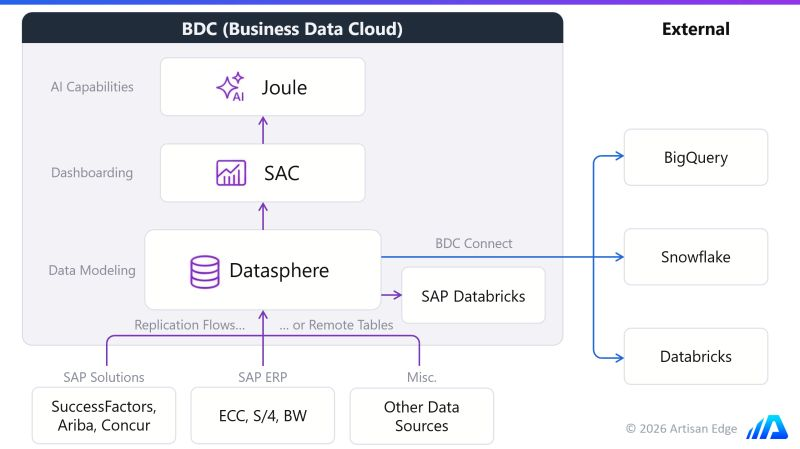
At SAPinsider in Las Vegas, the same conversation kept happening. Across booths, breakout rooms, and hallway chats, people wanted to know: what exactly is BDC? I heard the question enough times that I made a diagram on the spot. Here's the written version.
Datasphere is the foundation
At the core of BDC is Datasphere. This is where your data lives and where Data Products are published and consumed. Think of it as the spiritual successor to BW: all of SAP's products are either already integrated into Datasphere or planned to be.
For getting data in, you have two paths. Remote tables keep data in place, which is cheaper on storage but certainly worse on performance. Replication flows are delta-enabled and better suited when performance matters, but like any ETL pipeline is subject to breaking. Both feed into the same Data Product layer, where SAP's own products and partner-built products (like our SNAP Edge suite) live side by side.
Data Products themselves are a collection of SQLScript views, regular SQL views, and Analytical models that are built to represent data from a specific business purpose or functional area. The goal is that the output data from a data product is easily understood and utilized by both business users and AI, making Data Products the methodology for enabling meaningful value add from AI systems.
SAC and the shift in planning
SAP Analytics Cloud is still where dashboards get built, powered by the analytical models that Datasphere publishes. Planning has historically lived in SAC too, but SAP's Seamless Planning model moves that data back into Datasphere. This is better practice: it keeps Datasphere as the single source of truth instead of duplicating planning data in SAC.
Joule sits on top
Joule is SAP's AI copilot, and it connects to models in SAC through the “Just Ask” feature. In practice, this means a business user can query their data in plain language without knowing their way around a report. If your organization cares about data democratization, this is the piece that speeds up time to insight for the people who don't live in dashboards all day.
External data lakes and the zero-copy catch
The connections to external data lakes and lakehouses (Databricks, Snowflake, BigQuery, Fabric) are done via zero-copy delta share or data federation. No data actually moves into those environments. That's great for avoiding duplication, but federated queries are slower than working with local data.
If you want data materialized in an external environment, SAP calls that “Premium Outbound,” and it's fairly hefty charged. The exception worth knowing: SAP Databricks. Data processed through SAP Databricks is not considered to have left BDC, so it doesn't trigger Premium Outbound pricing. If you're evaluating architecture, understand this distinction early.
Your BDC Head Start
We've been building and enhancing SAP data products for decades, and all of SNAP Edge is now generally available as Data Products in BDC, listed on the BDC Marketplace. If you're standing up BDC and don't want to start from scratch, we should talk.
Our SNAP Edge Data Products are live on the BDC Marketplace. If you want proven, immediately-available Data Products in your BDC environment, reach out.